It’s a dangerous business, Frodo, going out of your door…You step into the Road, and if you don’t keep your feet, there is no knowing where you might be swept off to.
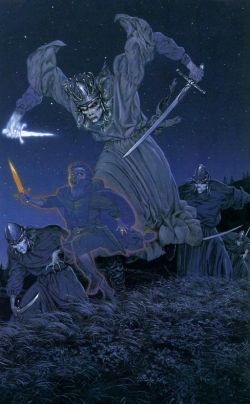
Now our travelers have had their first encounter with the Black Riders but not until after Fatty Bolger became the unsung hero of Crickhollow. After the trials of the Midgewater Marshes the Hobbits and guide Strider make for Weathertop. Safety can not be found and as they find evidence Gandalf may have proceeded them by a few days the knife in the dark would change their flight drastically.
When I read this chapter I was so impressed by Fatty Bolger's bravety. What a hobbit...the kind old Bilbo told Frodo about. I think it was at this point I realized that is was perfectly sensible to think Frodo was up to the task. If his countryman could over come his sense of fear to rouse the town against the Black Riders Frodo could indeed make a good go at the inevitable.
And I love the tying of loose ends even this close to the beginning of the saga. The flashes in the sky seen by Frodo and Strider linked to Gandalf's unseen battle on Weathertop left me with a sense of awe of Galdalf's power as yet to be seen.
Last edited by Philipa on Sun Dec 11, 2005 2:01 pm, edited 1 time in total.
This is one of my favorite chapters. It has Tolkien's wonderful descriptive imagery of the land they travel through, plus we meet Bill the pony. And Sam's (partial) recitation of the Fall of Gil-Galad, which is still one of my favorite bits of poetry in the book. (Like the hobbits, I wish I could have heard the whole thing.) Strider's tale of Beren and Luthien, and the description of him as he tells it. Who knew at this point how much that story truly meant to him?
It's funny, but when I first read the books I passed over most of the longer poetry--I was impatient. On subsequent readings I slowly absorbed the lengthier pieces--all part of the 'unfolding' of the story for me.
Has anyone else noticed the wounding of the hero from which he would never fully heal repeated in the Lord of the Rings? This chapter is a wonderful tapastry of the three ages into one scene. The lay of Beren and Luthien, Gilgalad, and the deadly might of the Nine Walkers on Amon Sul. Tolkien actually saw his beloved Edith dancing in an open field and was immediatly smitten by her grace and lovelieness. This motif often is repeated in several stories. Is not also classic Tolkien to have Strider explain that the lay was in a form of Elvish that didn't readily translate into the common tongue, and called his rendition of it, a mere echo?
I always enjoy Sam's comment about the midges, not at him, but his wit, what do hey eat when they can't get Hobbit? Its is also of note how flies accompany dire peril and how the Nazgul are afeared of the classic elements, this time fire, and as we see later of water.
Bruce
Mornie utlie
Believe and you will find your way
Mornie alantie
a promise lives within you now
Francoise wrote:Strider's tale of Beren and Luthien, and the description of him as he tells it. Who knew at this point how much that story truly meant to him?
The one poem I never skipped while reading... It's hypnotic, but am still afraid I must go back to the Strider thread and post again, what I haven't been able to post for these last two weeks of toil in the wilderness.
Out of doubt, out of dark, to the day's rising
he rode singing in the sun, sword unsheathing.
Hope he rekindled, and in hope ended;
over death, over dread, over doom lifted
out of loss, out of life, unto long glory.
Yes, Francoise and bruce the telling of ancient tales did so much for me when I first read this chapter. This particular chapter had me hooked to learn more about the Elves.
bruce wrote:
Its is also of note how flies accompany dire peril and how the Nazgul are afeared of the classic elements, this time fire, and as we see later of water.
I had completely forgotten about the elements and the Nazgul's aversion to them. Perhaps another parable to modern worlds aversion to worshiping the ancient respect of the elements? Far fetched? I don't know I'm just thinking out loud.
I have similar thoughts on this, Philipa: I think it's one of Tolkien's ways of showing us just how unnatural the Nazgul are, these dark undead.
Just a side thought: I've read LOTR so many times that having the characters call the Ringwraiths 'black men' doesn't faze me as politically incorrect any more. But what about some of you more recent readers? Is Tolkien being racist?
Sing and be glad, all ye children of the West,
for your King shall come again,
and he shall dwell among you
all the days of your life.
Merry wrote:
Just a side thought: I've read LOTR so many times that having the characters call the Ringwraiths 'black men' doesn't faze me as politically incorrect any more. But what about some of you more recent readers? Is Tolkien being racist?
Nah, not being a racist although when I tell my children who these 'bad ghosts' are I tell them they are called 'black riders' because they wear black. I also intertwine Nazgul so they know they have more then one name.


 It's hypnotic, but am still afraid I must go back to the Strider
  thread and post again, what I haven't been able to post for these last two weeks of toil in the wilderness.