Page 9 of 15
Posted: Mon Sep 22, 2008 2:11 pm
by Lindariel
VERY nice, ladies! Now I must get busy on my entry! Merry, thanks so much for leaving all of the shenanigans in Laketown for me -- plus "I am Thorin son of Thrain son of Thror King under the Mountain! I return!" (Can't wait to see that moment in the movie! PLEASE let it be every bit as pompous and ridiculous as it sounds in the book!) and "Thag you very buch." Just delicious stuff to play with!
Posted: Wed Sep 24, 2008 7:09 pm
by Iolanthe
Just catching up with these last two entries - very interesting as always

. I always come away from reading them with new ideas as though I'm re-reading the book through fresh eyes.
Posted: Fri Oct 03, 2008 3:09 am
by Lindariel
Here's my entry for October 9. Your comments for further perfecting it are welcome! Riv, please attach the appropriate illustration. Thanks!
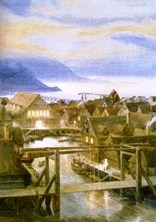
October 9: The company departs Lake-town by boat.
It would seem that our modern-day politicians have absolutely nothing on the Master of Lake-town when it comes to corruption and the capacity to talk out of both sides of one’s mouth simultaneously. Thorin & Co.’s sojourn in Lake-town certainly draws and refines a number of very interesting character portraits.
The further illumination of Thorin’s personality is particularly interesting. He is the first of the dwarves to be “de-embarrelled” by Bilbo, and of course, he is thoroughly bedraggled, sore and stiff, in an exceptionally foul mood, and not feeling especially grateful to the little hobbit who secured the dwarves’ release from the Elvenking’s fortress, despite the extraordinary odds against him achieving such a feat.
Bilbo, bless him, isn’t about to take any guff off Thorin, “Well, are you alive or are you dead? . . . Are you still in prison, or are you free? If you want food, and if you want to go on with this silly adventure – it’s yours after all and not mine – you had better slap your arms and rub your legs and try and help me get the others out while there is a chance!” Our little hobbit has certainly learned to speak up for himself, hasn’t he?
After a good bit of struggle, they manage to “de-embarrel” the rest of the dwarves. How does Thorin exert his authority once his team has been reassembled? He asks Bilbo, “In the meanwhile what next?” The dwarves – including the great Thorin Oakenshield – are increasingly relying on Bilbo, not for burgling, but for ideas and LEADERSHIP!
We should note, however, that Thorin only does so within the privacy of their little company. Once they reach Lake-town, Thorin steps to the fore and loudly proclaims himself, “Thorin son of Thrain son of Thror King under the Mountain!” The force of his personality must have been absolutely tremendous, otherwise surely such a pompous declaration made by a dirty, sopping wet, bedraggled dwarf would only result in general hilarity.
What follows is certainly a masterful description of the political intrigue one is bound to encounter in any sizeable village. Although the Master of Lake-town doesn’t believe Thorin’s claim one bit and is concerned about incurring the wrath of the Elvenking, the townpeople become so immediately carried away by the thought of the old legends coming true that the Master plays along and hosts Thorin and Co. most handsomely to please the populace. He figures they’ll be quickly revealed as frauds, at which time he can turn them over to the Elvenking, thereby retaining both his local popularity and his lucrative business alliance with the Mirkwood kingdom. A clear example of government policy based on popular opinion polls!
The dwarves themselves become more than a little carried away by the general excitement, parading about as though the gold had already been won and seeming to forget about the small complication known as Smaug the Dragon. Who hasn’t forgotten about this most important detail? Bilbo Baggins, who got a good look at the Lonely Mountain during his hazardous trip down the river. Plus, the Professor informs us that Bilbo has also contracted a “shocking cold,” which turns him into a sneezing, coughing bundle of misery who can only choke out, “Thag you very buch,” for his banquet speeches.
At length, Thorin has the sense to realize that he will need the assistance of the Master and the people of Lake-town to outfit his company for the final leg of their Quest and that it would be best to ask for that help while they are still so wildly popular. This gives the Master pause, but he is more than happy to be rid of his expensive guests, saying, “Certainly, O Thorin Thrain’s son Thror’s son!” while at the same time thinking, “Let them go and bother Smaug, and see how he welcomes them!”
So, on this day, Thorin & Co. at last departed Lake-town in three large, well-provisioned boats. The dwarves were excited, the people were singing. “The only person thoroughly unhappy was Bilbo.”
Posted: Fri Oct 03, 2008 3:23 pm
by Merry
Wonderful account, Lindariel! I, too, had thought that the Professor's account of Laketown politics was a touch of modernity added into the fable. I wonder if this was the mythologizing of something political going on during his time.
Posted: Fri Oct 03, 2008 7:30 pm
by Lindariel
Possibly, Merry. But I have a feeling that two-faced, slick-talking politicians are an unfortunate by-product of human civilization, be it small villlage or huge nation. It would be interesting to know if the Professor had a particular local politico in mind when he was dreaming up the Master of Lake-town, because the characterization is so apt it seems to have been taken directly from real life.
Posted: Fri Oct 03, 2008 7:39 pm
by Riv Res
Oh!! I do like that one Lindariel!! Politics never makes it easy does it?

Posted: Fri Oct 03, 2008 8:57 pm
by librislove
I think the mayor is much more likely to have been a representative of double tongued politicians in general--when you consider what happens to him later, that's too much a comic turn gone tragic to reference a real person-it's more like the poetic justice we'd all like to take sometimes.
Posted: Thu Oct 09, 2008 10:29 am
by Iolanthe
This one again
or this one?
 October 12: They leave the River and Ride to the Lonely Mountain.
After the comforts of Lake Town, Thorin’s party turn north for the last part of their journey and receive, very quickly, a large dose of reality. They meet a party with horses and provisions at the north end of the lake who quickly leave them with the words that it was “…easier to believe in the Dragon and less easy to believe in Thorin in these wild parts” putting an end to the puffed up pride that Thorin used to bolster his courage in Lake Town. The Lonely Mountain “grim and tall” grows ever nearer. The land is pathless and desolate – indeed it is “The Desolation of the Dragon” and their spirits plunge. Even though there is no sign of the Dragon himself, they are now in his territory with everything that that entails and the realisation of the true magnitude of their quest starts to hit home. Only Thorin and Balin have any idea what lies ahead, being survivors of Smaug’s attack. In fact it is only at this point in the story that we discover that Balin was also there, alongside Thorin. What memories and depressing thoughts must have been aroused by the sight of the ruination of a once ‘green and fair’ land.
It is here that Tolkien shows us that there is more to a Dragon than the immediate possibility of becoming at worst, charcoaled and, at best, rather singed. In Tolkien they are great destroyers of entire landscapes, creating a wilderness that nothing can live in. In fact all of Tolkien’s ‘monsters’ are destroyers of the natural environment, not just people: Morgoth, Sauron, Saruman, Orcs, they all create a lifeless wilderness for themselves by their very nature - they are destroyers of natural creation (i.e. anything not created by themselves). So there is more to the task ahead than just regaining the Lonely Mountain, there is a whole land to heal if there is ever to be food and trade. And it’s very quickly apparent that Thorin’s folk weren’t the only ones to suffer. The ruins of Dale, which Balin, Fili, Kili and Bilbo see when they are sent scouting for the hidden door, are a reminder that once the Dragon is gone there are other disposed peoples with their own claims to the Desolation of the Dragon.
And as for the Dragon himself, there is even more discomfort when the scouting party see smoke issuing through the cavernous entrance to the Mountain. Bilbo takes it as a sign that the dragon is home (something to lose sleep over in itself) but Balin points out that the foul reek would still issue from it even if the dragon were away, or possibly “lying out on the mountainside keeping watch”. A Dragon in a hole is better than a Dragon keeping watch, by anyone’s reckoning. The dwarves are now completely dispirited but, astonishingly, Bilbo is energised by the whole thing and starts pondering the map and moon-letters in search of clues to the hidden door.
Posted: Thu Oct 09, 2008 1:14 pm
by Lindariel
Very nice Iolanthe! The "Desolation of the Dragon" is something of a mild precursor to the utter ruin of the Morannon, the nightmare of the Morgul Vale, and the horrors of Mordor.
October 14--CAMP IS MOVED TO THE WESTERN VALLEY
Posted: Tue Oct 14, 2008 5:31 am
by librislove
( I think we will have to use the same picture as the previous entry....)
In keeping with his newfound interest and determination, Bilbo prods the dispirited dwarves to move camp to a place where they can begin their search for the secret door in earnest. The group moves to the western slopes of the Lonely Mountain, finding a sheltered valley with grass for their patient, long-suffering ponies, and fewer signs of dragon activity. The camp, while safe, is dark and cheerless, shadowed all day by the cliffs and mountain wall above. From this base, the group searches through the days in parties of two, casting for the path to the door.
And at last they find it--it should be no surprise by now that it is discovered by Bilbo and the two youngest dwarves Fili and Kili, who choose October 14 to explore a narrow, tortuous path above the camp that leads to the hidden bay where the door, without any obvious markings yet still recognizable for what it is, lies some 150 feet above the base camp. The excited young dwarves and the hobbit beat and push on the door, and speak some spell fragments to it, but nothing happens. Only temporarily defeated, they descend to the camp, where their discovery heartens Thorin and the others, and they prepare to move again, their goal finally in sight. As we will see, their elation is a bit premature, primarily because, as we already know, dwarves never listen!
Posted: Tue Oct 14, 2008 11:38 am
by Riv Res
Very nice librislove!
Posted: Sun Oct 19, 2008 9:27 pm
by elentarivarda
crappity crap crap!
sorry friends, but I did my entry at work and left it on my work machine! *face palm*
So, I'll quickly try to remember what I wrote and get it put together and posted. Sorry it's late!
Posted: Sun Oct 19, 2008 10:19 pm
by elentarivarda
Ok, here we go!
 October 19 - Bilbo discovers the hidden path. The camp is moved to the hidden bay.
018hoblee.jpg
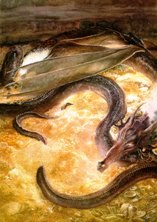
Smaug lay, with wings folded like an immeasurable bat,...
In this section, we have one of Tolkien's many riddles. Bilbo and the dwarves do not remember the riddle at this point, so the dwarves let their frustrations overcome them. They beat at the door with their axes. Of course, this doesn't work, so they retire. But, Bilbo sits and ponders, trying to remember the riddle. His patience proves valuable, since during his pondering a thrush comes and knocks on a snail, reminding Bilbo of the riddle. He then remembers how to get inside.
This is a good example of the contrast of our characters in this story. As the dwarves get closer to the treasure, they get more and more stubborn and make more mistakes since their minds are only on the treasure, and not on the path and journey. Bilbo, on the other hand, is learning as he goes. He is growing and applying all the experiences of this journey to the decisions he's making. His decision to take and hide the most coveted of the treasure from the dwarves, and convince them to take refuge in the hidden bay, is a decision made because the dwarves do not seem to have the ability to think about protecting themselves. They are only thinking about treasure, whereas Bilbo is thinking about the whole picture.
I think this passage is a good example of how Tolkien incorporated messages of strength, honor, and how to live a good life within his work. He is showing us that Bilbo is gaining a much more precious thing from this journey than the dwarves are. Bilbo is gaining wisdom, patience, courage, and initiative. The dwarves think the journey is only about the treasure they seek, and fail to learn from the experiences they encounter. What good is a journey, if you do not grow and learn from it?
Posted: Mon Oct 20, 2008 12:25 am
by librislove
Nice entry! And considering I forgot mine entirely until reminded by our ever-vigilant Riv Res, you have nothing to apologize for. Tolkien seems to have realized a great truth in his depiction of Bilbo--for any group to function, perhaps there needs to be one member who stands a bit apart from the excitement of the immediate goal--one who can keep everyone in some kind of balance.
Posted: Mon Oct 20, 2008 4:08 am
by Merry
This is great! Insights such as this are why I enjoy this so much! I never thought about contrasting their actions in this way. Well done, indeed, e-varda--it was worth the wait!