Page 10 of 15
Posted: Mon Oct 20, 2008 4:16 am
by elentarivarda
Thanks!

It's interesting that our study this week in church was on embracing your experiences, good or bad, and learning from them...then applying that learning to your life.
I sat in church thinking, wow...how cool is it that these two seemingly unrelated parts of my life (MeJ and church) could meet at an intersection like this!
Actually, I think my quick 'replacement' entry was more insightful then the one I did earlier in the week! I had an added bonus of having this 'embrace our experiences' lesson in my brain.
Posted: Sun Oct 26, 2008 9:54 am
by marbretherese
Here's the next entry - I'd like to keep the same picture as the previous couple of entries, please, Riv:
018hoblee.jpg
Smaug lay, with wings folded like an immeasurable bat,...
October 30 (Durin‘s Day): the Secret Door is opened at dusk. Bilbo visits Smaug and returns to the dwarves at midnight.
Having left it to Bilbo to solve the problem of opening the Secret Door, Thorin now expects Bilbo (in his capacity as Burglar) to go down the tunnel and reconnoitre the dragon’s lair - a classic example of asking someone to do something you won’t do yourself. Bilbo makes it plain to Thorin that he’s not impressed by this attitude. Nevertheless, Bilbo is willing to do what Thorin wants (“Perhaps I have begun to trust my luck more than I used to in the old days“). Bilbo's experiences since leaving Bag End have made him more confident in dealing with Thorin and more prepared to face danger.
Only Balin is prepared to accompany him even part of the way, and once again Bilbo is forced to face the unknown on his own: “Going on from there was the bravest thing he ever did . . . He fought the real battle in the tunnel alone, before he ever saw the vast danger that lay in wait.” This brief passage sums up the essence of fear and how to deal with it (perhaps Tolkien was recalling his experiences in the Great War at this point). The Bilbo who prepares to face Smaug bears little resemblance to the cautious hobbit who set out from the Shire six months previously.
The name Smaug is the past tense of the Old Norse verb smjúga - to creep through an opening (cf. the Old English “sméogan wyrme”, which means “creeping worm”) - a good example of Tolkien’s word-play. Tolkien had become familiar with the mythology of dragons when studying the Old Norse sagas: “A dragon is no idle fancy. Whatever may be his origins, in fact or invention, the dragon in legend is a potent creation of men’s imagination, richer in significance than his barrow is in gold. Even to-day (despite the critics) you may find men . . . who yet have been caught by the fascination of the worm.” * And Tolkien was one of those who had been thus caught!
And what a barrow Bilbo discovers when he eventually plucks up the courage to enter the treasure-filled cave where Smaug lies sleeping on top of a pile of gold and jewels! Tolkien says that “there are no more words left to express his staggerment” (the earliest written record of this wonderful word “staggerment” is believed to be in one of Tolkien’s own letters**). Awed as he is, Bilbo has enough wit to grab a great golden cup and run back to Balin, who carries him out of the tunnel. So Bilbo has indeed become the Burglar the dwarves wanted him to be, but their delight is cut short when Smaug discovers the theft and leaves the mountain in a rage, seeking the culprit . . .
* Beowulf: The Monsters and the Critics, 1936
** Ring of Words, Gilliver, Marhsall & Weiner, OUP 2006
Posted: Sun Oct 26, 2008 10:56 pm
by Merry
An erudite entry, marbretherese! I haven't read the Beowulf essay yet--maybe January. I must confess, though, that I don't have the dragonlust that Tolkien is talking about. They give guys a chance to be heroes, I guess, but I'm more interested in the heroes than the dragons!
Posted: Mon Oct 27, 2008 8:58 am
by Iolanthe
I'm a dragon fancier myself - I think the whole idea is fascinating!
I'm slow catching up with all these essays but they've been so interesting - Tolkien's careful use of words, Bilbo's gaining something more precious from the trip than the gold the dwarves are fixated on. We're peeling back the outer layers of The Hobbit and finding hidden treasure ourselves

.
Posted: Mon Oct 27, 2008 11:58 am
by Iolanthe
I'm posting this early as I will be off to Ireland on Wednesday and wanted to get it done:
Perhaps this picture again:
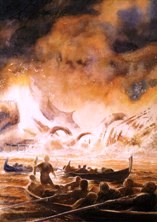
020hoblee.jpg
Full on the town he fell.
Or this one:
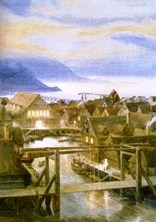
017hoblee.jpg
"..in meanwhile what next?"..."I suggest Lake-town,"...
November 4: Elves turn towards Lake-town.
Thanks to the foresight of Bard, who is now running Lake-town if not ruling it, the King of the Elves is stopped in his march towards the Lonely Mountain. He feels pity on hearing the prayers (interesting word to use instead of plea or request) of Bard and turns his considerable army south towards Lake-town to give them aid. Although there are not enough boats and rafts for his host, he immediately sends food and provisions by the quicker route, taking his army round by foot over treacherous lands.
This short passage, although brief in words, is long on insight into the Elvenking, Bard and the relationship between Mirkwood and Lake-town. The last time we met the Elvenking he was full of wrath because the stubborn dwarves refused to account for their journey into his lands. His rather harsh (but understandable) decision to throw them into a dungeon until they came to their senses has, up until now, cast him in the role of a rather dangerous and scary character. But here we discover that he is the ‘good’ leader of a ‘kindly people’. He makes another swift decision, and moved by pity he shows that he is as quick to aid as he was to anger. For Bard he is the obvious person to turn to in a time of extreme trial. We know that there has been a trade relationship between the Wood-elves and Lake-town, but Bard is banking on it being something more and shows us that there is friendship and mutual support between the peoples that live close to the dragon. For the people of Lake-town, Bard’s appeal and the Elvenking’s decision is the difference between life and death.
Tolkien pulls no punches in relating the aftermath of the dragon’s attack. This is the familiar aftermath of a disaster: shock, displacement, sickness, hunger, loss of life for the vulnerable that survive the initial trauma. How familiar it all is. And all in a story seen as a children’s fairytale!
Posted: Sat Nov 01, 2008 12:50 am
by Merry
Time marches on! I've got Nov 2, and I'll write it tomorrow but, RR, you've got the death of Smaug on Nov 1, an important account! Are you working on it, or have politics taken you completely?

Posted: Sat Nov 01, 2008 12:55 am
by Riv Res
Thanks for the reminder! I am chasing my tail per usual.

Posted: Sat Nov 01, 2008 3:48 am
by Merry
I'm not far behind you! (Chasing my own tail, of course, not yours!

)
Posted: Sat Nov 01, 2008 2:25 pm
by Riv Res
Bilbo returns to Smaug’s chamber in the afternoon. In the evening Smaug smashes the door, attacks Lake-town, and is killed.
“Never laugh at live dragons, Bilbo, you fool!”
November 1 is one of those all inclusive Tolkien cataclysmic days. So much happens in an afternoon that it is hard to comprehend it all and keep one’s timeline straight.
Bilbo has his final conversation with Smaug and succeeds in stirring the dragon’s anger to the breaking point. His rather careless boasting and dropping of hints finds it’s mark. Bilbo is scorched but eludes the enraged Smaug. Leaving his lair and searching for the intruder, Smaug is further incensed at not finding anyone. He take out his fury on the mountainside, and the Dwarves and Bilbo barely escape into the mountain tunnel. Convinced that Bilbo is aided by the Men of Lake-town, Smaug roars off to reek his vengeance there. Bilbo’s words indeed pointed him in that direction.
I am always struck by the Dwarves overwhelming pre-occupation with the golden hoards under the Mountain. It consumes their every waking moment and here it is no exception. Even living with the growing fear of the awakening Smaug and the danger that he presents, there is no talk of warning Lake-town. There is little talk of much else but the treasure, even when the frightened Bilbo issues his warnings.
So into the Mountain they go and while Lake-town is besieged, the Dwarves marvel at the golden treasure so long guarded by the Dragon. They are uneasy, but enraptured. This is also the day that Bilbo receives his priceless shirt of Mithril that plays such an important role many years hence.
Tolkien has chosen an unlikely hero in that of the thrush who has watched and listened to all that has transpired on the Lonely Mountain. Thorin explains the thrush’s alliance with the Men of Lake-town, and today the thrush proves its worth.
At Lake-town, the people see the golden light coming from the Mountain and are overjoyed thinking that the King Under the Mountain had returned to ‘forge’ his gold. They are soon terrified at the approach of Smaug and it is the thrush who shows Bard exactly where the dragon is weakest, and thus brings the Smaug to his end. For all his horror and might, in the end, Smaug is revealed to be just as vulnerable as any Hobbit, Dwarf, or Man. Thanks to Bilbo and the thrush, Bard knows just where to shoot that fateful arrow.
Posted: Sat Nov 01, 2008 2:33 pm
by Merry
'Incensed' is a good word to use about Smaug!
Posted: Sat Nov 01, 2008 2:35 pm
by Riv Res
Yep...thought that was appropriate.
Posted: Sat Nov 01, 2008 3:12 pm
by Merry
November 2: Goblins, Beorn and Gandalf hear of Smaug’s death.
(I'm not sure that there is an appropriate illustration for this one.)
Just as stories must ascend to their climax, they cannot just end there, but must descend to their endings. Smaug's death is certainly the central event of
The Hobbit, but perhaps not the most meaningful, and Our Author must begin immediately to build the minor crescendoes. The devastation of Esgaroth, with one-quarter of the people of Lake-town dead, is the immediate theme, as is the political situation: with confidence in the corrupt Master low and Bard the Bowman presumed to be dead:
And in the very midst of their talk a tall figure stepped from the shadows. He was drenched with water, his black hair hung wet over his face and shoulders, and a fierce light was in his eyes.
"Bard is not lost!" he cried. "He dived from Esgaroth, when the enemy was slain. I am Bard, of the line of Girion; I am the slayer of the dragon!"
"King Bard! King Bard!" they shouted; but the Master ground his chattering teeth.
(Doesn't this remind you of a similar scene in
The Lord of the Rings?)
Although Bard declined the kingship (since his ancestors were lords of Dale and not Kings of Esgaroth), he still took charge of relief and recovery and sent messengers to the King of the Woodland Elves for aid. But the messengers found the elves already on the way:
The Elvenking had received news from his own messengers and from the birds that loved his folk, and already knew much of what had happened. Very great indeed was the commotion among all things with wings that dwelt on the borders of the Desolation of the Dragon. The air was filled with circling flocks, and their swift-flying messengers flew here and there across the sky. Above the borders of the Forest there was whistling, crying and piping. Far over Mirkwood tidings spread: "Smaug is dead!" Leaves rustled and startled ears were lifted. Even before the Elvenking rode forth the news had passed west right to the pinewoods of the Misty Mountains; Beorn had heard it in his wooden house, and the goblins were at council in their caves.
War was building.
Posted: Sat Nov 01, 2008 3:58 pm
by Riv Res
Great entry Merry!
I'll play around with the images.
Posted: Sat Nov 01, 2008 8:39 pm
by librislove
Wonderful entry, Merry! The point in the story where the fairytale gives way to a more adult tale, when the dwarves and others, and the reader, find out that there is an aftermath to the dragon's death which does not necessarily
include "happily ever after."
Posted: Sun Nov 02, 2008 3:05 am
by Lindariel
Wonderful entries, ladies! Now I must get busy with mine!