Page 4 of 33
Posted: Tue Oct 04, 2005 5:08 am
by Merry
" . . . he invented nothing cynical": what a great comment! Thanks for this article, Varda. I think this author hits the nail on the head. "The book is apparently beyond scholarship and criticism; nothing written about it seems to be about the same book that people begin again as soon as they reach the end, or read for days without sleep, or can allude to like a Puritan quoting Scripture." How true!
Posted: Tue Oct 04, 2005 4:50 pm
by bruce rerek
Merry,
After reading the various biographies and lectures about the Professor, I can not think he could write anything cynical. The person I have come to know as Tolkien was a very sensitive man who had every right to be bitter about life, (his orphange, the war, Edith's family, and a career that was very frustrating at times) yet he did not laspe into self pity.
His love for his work as well as for Edith and his children were his career. He did it with grace and a charm that can only be described as, well, hobbitish.
Posted: Tue Oct 04, 2005 10:21 pm
by Merry
I quite agree, Bruce. I think our author is a man who put it all out there: everything he loved and all his experience is on display in his works. He wore his heart on his sleeve, as they say.
Posted: Wed Oct 05, 2005 1:57 pm
by bruce rerek
I also recall from the George Sayer recollections that the Professor loved to lag behind the Lewis brothers on hikes and study the flora and fauna. It would not be a stretch to understand how his landscape of Middle Earth was so populated with so many varities of plants, trees, and various animals.
As a person who has often been described as wearing his heart on his sleeve, I can well identify with the Professor's sensitivity. Still to this day I do not understand why that is more of a criticism than a compliment. Perhaps for those who dun their emotions came the claim of a life of quiet desperation.
Posted: Wed Oct 05, 2005 6:37 pm
by Merry
My impression is that, in person, Tolkien might have been your typical 'reserved' Englishman, except, perhaps, with his children. So I don't think he wore his heart on his sleeve in that way. But he really did reveal so much about his loves to millions of people through the books. Think about Beren finding Luthien dancing in the woods: a reenactment of a very private interlude with Edith. And isn't Iluvatar his revelation of his own view of God? All the way from these heights to mushrooms and fancy waistcoats and simple woodland flowers.
I feel like I know Tolkien the man better than I do some of my friends and family!
Posted: Thu Oct 06, 2005 1:10 am
by Philipa
The last five posts have traveled from the Tolkien News thread. Please carry on. 
Posted: Tue Oct 11, 2005 10:05 pm
by Philipa
Referring to the latest news of small people's remains by archealogists...Hobbits in our past? This would be quite interesting in the monkey chain don't you think?

Posted: Sun Oct 23, 2005 3:42 pm
by bruce rerek
Oh folks, came across this site and thought you might want to check this out.
http://www.chem.ox.ac.uk/oxfordtour/tol ... index.html
Posted: Sun Oct 23, 2005 6:02 pm
by Philipa
That is very interesting bruce. Timelines are always useful.
Posted: Tue Oct 25, 2005 4:18 pm
by Iolanthe
That's great! Especially useful as I'm about to start reading Tolkien's biography
. Thanks Bruce.
Posted: Tue Oct 25, 2005 5:11 pm
by bruce rerek

You are more than welcome, Enjoy
Posted: Wed Oct 26, 2005 1:17 am
by Riv Res
The Great Years Calendar: The Council of Elrond
We have special entries for The Great Years Calendar during the month of November. Be sure to visit the Calendar often.
October 25 is undoubtedly the single most important date in the early annals of the War of the Ring. This is the day that the Free Peoples of Middle-earth make a decision that will shape their future for all time. Differing ideas are debated; sobering accounts of the history of Middle-earth are told; mysteries are unraveled, and both fears and hopes are kindled. The reader is given more insight and history and motive in this one incredible chapter than anywhere else in Tolkien's epic tale.
Needless to say, one short Tolkien Calendar post cannot begin to express the significance of the Council, and so we will talk about it in installments. You will want to check in with the Calendar in the weeks to come and learn about the Council of Elrond from 4 different perspectives.
11-1-05: The Council of Elrond: The Players. Who were the key players in the Council? Why were they key players? What role did they play throughout the Council?
11-8-05: The Council of Elrond: Middle-earth History. What were the historical events that took place in Middle-earth and were discussed at the Council? What key historical events shaped the Council and it's results?
11-15-05: The Council of Elrond: The Decisions and Implications. What did the Council decide to do? What did they consider and throw out and why? What was the significance to the rest of the story.
11-22-05: The Council of Elrond: Tolkien's Literary History. How did Tolkien arrive at his final draft for the Council? What other versions did he consider and disgard and why? What was the literary significance of the final draft?
Join us for these fascinating Calendar posts in November.
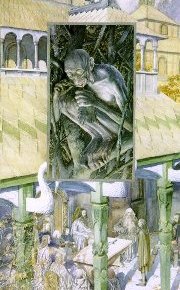
Artwork: "The Council of Elrond" by Alan Lee
Posted: Mon Nov 07, 2005 12:08 pm
by Cassandra
I watched a documentary on German Television yesterday. It was about the siege of Vienna by the Ottomans in 1683. Vienna was built on a geographically very important position for the occident. With the fall of Vienna, it would have been likely that we all would be Moslems now. Vienna was besieged for more than 60 days by about 180.000 Turks. At the end there were only about 4000 defenders in the city left, the rest was dead or wounded. Vienna was the most modern stronghold at that time, it had a huge city wall with a wide ditch. The Turks had 5000 so-called Mineure, that were men who dug a system of tunnels underground and laid mines on the most effective places to destroy the wall. They had done a pretty good job and there was only one other explosion necessary and the wall would have come down and Vienna would have been lost. The defenders tried now themselves to dig tunnels and to prevent the explosions by finding the mines in time. But help was on the way from the North, it was an allied army of several countries with the King of Poland as Supreme commander. Beacons were lit, as a sign, that they were near. The whole Christian army, about 80.000 soldiers, attacked the Turks. But it was the Polish King, Jan Sobieski - who came late - with his steel-clad riders, with wings on their backs, who overwhelmed the Ottomans.

The battle was known as the Battle at the Kahlen Berg. Meanwhile in the city, the mineures were able to dig a chamber underneath the wall, with so much gun powder in it, that the wall would break. The defenders found this chamber in the last minute, the fuzes were already burning. They managed to put the fire out. The Turks were driven back in the East, this was the end of the Ottomanian efforts, to conquer Europe and the beginning of the rise of the Austrian-Hungarian Empire. And it was the day, when the occident was saved, on 12. September 1683. I knew, that Vienna was besieged, but I didn´t know all these details. The whole story reminded me of a mixture of Helms Deep and Minas Tirith. Has anybody ever heard if Tolkien took this event as a role model? I have always thought, that only old myths were role models, but this was true history. But it sounded like a true Tolkien story with an Eucatastrophe in the end to me.
Cassandra
Posted: Mon Nov 07, 2005 1:27 pm
by Estel
Cassandra wrote:I watched a documentary on German Television yesterday. It was about the siege of Vienna by the Ottomans in 1683. (---)
I knew, that Vienna was besieged, but I didn´t know all these details. The whole story reminded me of a mixture of Helms Deep and Minas Tirith. Has anybody ever heard if Tolkien took this event as a role model? I have always thought, that only old myths were role models, but this was true history. But it sounded like a true Tolkien story with an Eucatastrophe in the end to me.
Would love to hear if Tolkien had been inspired by this siege.
Had no idea either, I read about it in school, that the Ottomans were stopped effectively at Vienna in 1683, but no idea about the details. That it was so close

, that the numbers were so uneven, that Vienna was saved in the end by a great allied army. Sounds familiar.

The only thing that seems interesting with the siege of Vienna nowadays is that coffee arrived in Europe then.

(Swedes are among the worst coffee drinkers in the world, probably the worst.
) I've read one of Sienkiewicz' novels about Polish 17th century history, have seen the Polish riders with their wings on film, but have missed the siege of Vienna.

Shame on me.
Still I may have saved a tree today.
A neighbour wants to cut down his Japanese cherry tree, but I made him see the beauty in it and it's own value as an individual

. Am I turning into an ent?

Posted: Mon Nov 07, 2005 3:59 pm
by bruce rerek
Or perhaps you are becoming tree-ish.
I am quite sure the fall of Constantinople, the siege of Vienna, and the other historical battles all played as examples, but the Professor did create his own land and peoples. His battles were authentic to themselves. I actually mistook hauberk as a weapon and didn't realize that is meant chain mail.