A number of odd comments from me, as I also thorough enjoyed Oxonmoot at Christ Church. A few general remarks first
One of my standing regrets at Oxonmoots is that there is always too much going on at the same time. In the two or sometimes (certainly this year) three streams of lectures there is always more than enough that interests me to be fully occupied all time, sometimes wishing I could split myself in two - or had Hermione Graingers time-turner. As the dealing room and the art room are open almost precisely the same times as lectures are scheduled, and no longer, this leaves me with no time to enjoy the art on show. I just managed to squeeze in about twenty minutes on Friday (in which Iolanthe's Denethor was the most memorable piece to draw my attention - pleasantly shocked, I think is the best description of my feelings) and when I decided to skip the last lectures on Saturday, after I had managed to get Ted's and Bob Blackham's signatures and buy the copies of Tolkien 2005 Proceedings I had been asked to bring back to The Netherlands, I found the art was already being taken down! I would also have liked to find the time to peruse the albums of photographs of TS events. So I definitely want to put in a complaint this time.
But that is just the one wrong note in what was a very good time!
Something not really part of the Oxonmoot programme, but still adding to my satisfaction was going to Evensong at the Cathedral four days in a row. And having 'How lovely are thy dwellings fair' drifting into the lecture room on Saturday from the memorial service being sung for the late Dean.
Now in the order of Iolanthe's reports and Marbretherese's additions:
1. Thursday evening.
After lugging my stuff up to my room (in Peckwater, so without view of the Meadow), Evensong and Thai dinner (with a Dutch-Belgian-German-Swiss group) I turned in to Hospitality, in time for the Telerin circle, which is where people read from their favourite passages in Tolkien's works. There was a large group this year, from many different countries, and we got lots of different passages, among which part of Mythopoeia, and the Lament for Eorl in Hebrew stand out. Meanwhile I wondered what I should read, and having settled on something, Christopher Kreuzer read from the Silmarillion the passages related to Fëanor's Oath and the Prophecy of Mandos. I responded by launching into my selection: Fëanor's Oath in alliterative verse from Lays of Beleriand, much to Christopher's enjoyment, and threw in the chorus from Alex and Ted's ballad on The Doom of Mandos:
Tears Unnumbered ye shall shed,
Echo of your Lamentation,
All things turn to evil end,
For the House of Fëanor.
Murray Smith and I rounded off with Húrin's defiance and Túrin's ravings respectively from Children of Húrin.
2. Friday morning.
Bearing in mind what I said earlier about the packed programme, it is no surprise that I went to quite different items than Iolanthe and Marberetherese. I went to Murray Smith's
'Princes Fictional and Real', centering on a quite interesting comparison of first Albert Victor Duke of Clarence and Avondale and his brother George Duke of York (George V) and second Edward David Prince of Wales (Edward VIII) and his brother Albert Duke of York (George VI) to the brothers Boromir and Faramir and to the brothers Baldor and Aldor.
Next came Heidi Steimel's
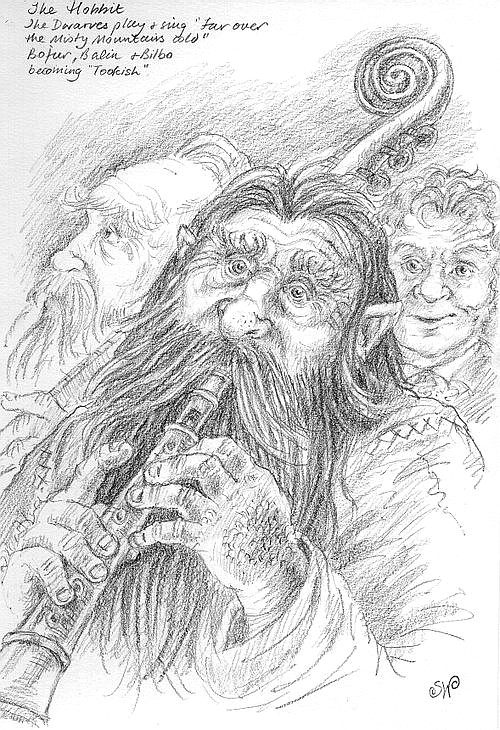
'Musical Instruments in Middle-earth'. Where would the Ainur get the instruments that in Lost Tales they are playing in the Void from? In the Silmarillion they have disappeared. And then there are: the trumpets of Manwë (did he play them himself, or had them blown?), the horns of Ulmo and Oromë, the harps of the Vanyar, the viols of the Noldor, the pipes of the Teleri, the harps of Maglor and Finrod, the horns of Buckland, Rohan and Mardil Voronwë, the harps, viols,lutes and silver horns of the musicians of Dol Amroth, that got cut from LotR, the Orcs' drums, and the Dwarves' fiddles, flutes, drum (Bombur signifying 'drum'), clarinets, viols and harp - all lost to the Orcs of the Misty Mountains - and finally, mentioned by Beregond: Farmer Maggot's hornpipe. With this went the Call for Papers for the volume of essays on Music in Middle-earth that Heidi will be editing (and Walking Tree will be publishing).
After which I attended the
Auction, and got in some friendly competition with Fangorn (which one can never win - still one can have some fun). It was reminiscent of the auction of Bilbo's possessions: a variety of things going for next to nothing or old songs. No-one wanted to bid for two volumes of HoMe (first printing A&U hardcover) that Christopher Kreuzer had shown me over breakfast (enough mushrooms for any hobbit!), being quite surprised that I thought them worth £50 - 100 each, maybe more. Auctioneer Wellinghall agreed with me on the valuation, putting a reserve on them, but there was no market.
The bowler-hatted chaps appear strictly speaking not to be (College) Porters, but 'Bulldogs', that is University policemen, reporting to the Proctor. I also had some chats with the friendly one, and heard the same reported by others (there is a nice picture of him with Angie Gardner and Lyn Willshire on Neil Anderson's Facebook); he called me 'squire'.
I'm sorry to have missed the Monteverdi Vespers (I heard the Bishop of Salisbury's performance at Milton Abbey some years ago), but of course I was occupied elsewhere by the busy schedule ... St. Cecilia, in the Burne-Jones window, is actually Alice's sister, as I found out when I did a round of the Cathedral after Sunday's Eucharist. Quite nearby I found a stone to the memory of Wystan Hugh Auden.
3. Rest of Friday.
In the afternoon I did not go to Ted's slide show - as I had seen it as recently as July at the German Tolkien Society's "Thing". Instead I went to Maggie Burns'
'Until the Dragon Comes', on Tolkien's activities and experiences in WW I, and some links with his works. The title links this 'War to end all wars´ to Beowulf, the dragonfight to end all dragons - for it is the closing sentence of Tolkien's famous Beowulf lecture; spoken in 1937 just when Germany had invaded the Rhineland ...
Then, the only time I went to the same stream as Iolanthe and Marbretherese, to Alex Lewis lecture about
On Fairy Stories: how Tolkien was 3rd choice to give the Andrew Lang lecture, for which he was paid half a contemporary workman's annual pay. Also how he changed his good opinions of Lang in 1939 to 'damning him with faint praises' in 1964.
After this, I had to hurry off to the Covered Market to order one of the wreaths for Enyalië.
"Mercury" is actually the name commonly used not only for the statue, but for the whole fountain and pond - even in the notice forbidding students to jump into it, which I found posted in Hospitality, a.k.a. the Junior Common Room. In Dorothy Sayers'
Gaudy Night, St. George, after having knocked over Harriet Vane coming out of the Cathedral, offers to drown himself "in Mercury" when he realises he has been saying all the wrong things about his uncle's love for her.
The "Bacon'd geezer" over the High Table was nicknamed 'hover-don' by the Cambridge Tolkien Society group.
After Evensong, Welcome Dinner, a long discussion in Hospitality about Elven linguistics, and the Undercroft Bar, I located a room party almost next to my own room in Peckwater, where Maddy Anderson and Mole (the 'chief Goon') were holding forth in song, both serious and rowdy.
4. Saturday.
This day, I found myself going to the same stream as Iolanthe and Marbretherese for the first lecture in the morning, Andrew Morton's
'The Influential Mrs Neave', and I've nothing to add to their reports.
After that Susan Edward and Beregond's group discussion
'Why learn Elvish languages', sitting in as 'friendly uncle' on what was really intended to get an Elvish Language Study Group underway in England. Susan had prepared a valuable list of good websites on the subject.
And so on to the
International Tolkien Fellowship, the meeting of representatives of Tolkien societies from across the world. Represented were: Britain, Switzerland, Germany, United States (two different states), Norway, Sweden, Austria, Israel and The Netherlands. Some topics were: links with other literary societies, and with other Fantasy/SF societies - involvements with possible bids for WorldCon in 2014 and/or 2015 - "Return of the Ring" conference in Loughborough 2012 - presenting the Tolkien societies in each others Journals (DTG have been doing this in their
Flammifer for several years) - Nordic Tolkien Festival in Norway, September 2009 - recent publicity - relations with Tolkien Estate and publishers.
In the afternoon I also went to Alan Reynolds and David Doughan's
'"On Fairy-Stories" revisited', nothing to add to Marbretherese's report of that. The Bells were ringing a quarter peal of Stedman's Caters, because of the memorial service for the late professor Chadwick, sometime Dean of Christ Church (and for good measure they rang a whole peal on Sunday), and this was when the Cathedral Choir was singing Brahms, Walford Davies and Palestrina (a.o.).
After this, I stayed on for the
Tribute to Pauline Baynes, but sneaked out when the talk turned to
The future of the Narnia Films, to go to the Dealers room for autographs and proceedings.
Finding the Art Room already closed, I then caught the second half of Ruth Lacon's
'J.R.R. Tolkien and the Medieval Trojan Legend', and there I found the lack of sleep taking over ... Still, I find quite a bit of notes in my pad - on links of
The Fall of Gondolin, not with the classical account of the Fall of Troy, but with the medieval one. Priam's son Helenus escaping with wife and child - Tuor, Idril and Eärendil. Priam's "commanding voice" - Turgon/Turukano = commanding voice. Mechanical dragons in FoG - Trojan Horse. Shining Tree of Troy - Two Trees of Gondolin, possibly the origin of the entire Two Trees motif. And: "Tolkien's remarkable habit of knowing the most obscure sources in Latin".
Lembas Extra is the regular academic journal of the Tolkien Society Unquendor in The Netherlands (
Lembas being its ordinary journal). It is roughly biennial, and its most recent issue (2007, but actually published this year) is the proceedings of the 5th Lustrum Conference in 2006 (Unquendor's 25th anniversary, and the Dutch LotR's 50th - hence the articles on translations, and Cor Blok's talk as the illustrator of the longest running Dutch edition).
As to St. Aloysius at the Oratory, Scull&Hammond (
Readers Guide) say that it was one of the churches that Tolkien attended as an undergraduate, and while living in Northmoor Road from 1926 to 1947. His son John said his first Mass there.
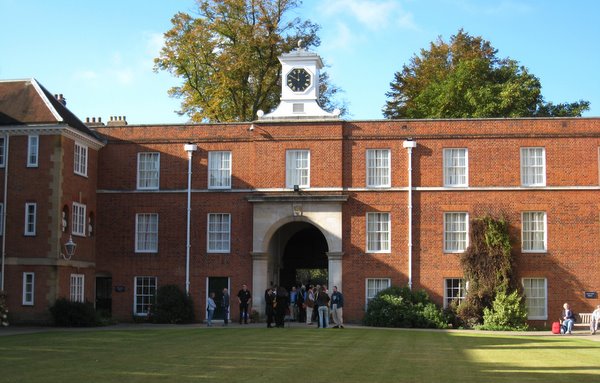
As to rooms in College: I found the quality of both rooms and meals in Christ Church a cut above other colleges (and universities) that I have had experience of. My room was bigger than any of the others I saw at CC, I could have had half the Oxonmoot attendance for a room party, but no-one wanted it for one.
5. Saturday evening, Sunday morning.
The One Van (a.k.a. The One-eyed Green Monster) belongs to René van Rossenberg of Tolkienshop.com.
Iolanthe's "Who?" singing with Ted is Caspar Reiff, the originator (with Peter Hall) of and prime force behind The Tolkien Ensemble. It was his setting of
The Road Goes ever On they were singing ... And the "somebody else" in Marbretherese's photo singing with Ted and Alex is Madeline Anderson, I think she's got a degree in music (and how great the difference between her 'professional voice' at that party, and her 'howling' at the roomparty the previous night!).
Joanna Tolkien commented on the lack of hair on my feet - for daring to dress up as a hobbit! Mole was quite shocked when I told him she'd heard most of his Goon show, but she was quite amused, really.
After the party (and taking down the 'tech' ) I visited both roomparties that were apparently going on - one in the new TS chairman's room across St. Aldate's, the other somewhere in Meadow building (and you thought it was quiet ...), both less lively than the Friday night party, especially after the night porter came to warn us for making a noise.
To be accurate, at Enyalië Denis Bridoux is not singing Namárië to Donald Swan's setting from
The Road Goes Ever On, his version is taken directly from Tolkien´s own singing on the tape-recording made by George Sayer (and sometimes available from the BBC or Caedmon Records). He is also singing the words Tolkien is singing there, which differ slightly from those in LotR and RGEO. Of course Donald Swan's setting is based on the same tune, which Tolkien also sang to him. At Heidi Steimel's lecture, Beregond told us it's actually the Gregorian chant to which the readings from the
Lamentations during Holy Week are sung.
Denis Bridoux is the gentleman on the left in Iolanthe's photograph with Joanna Tolkien on the right, standing apart from the crowd preparing himself mentally for the singing. Incidentally, after featuring me so prominently in the Moreton-in-Marsh-report, how did you manage to leave me out of that photograph, with both Hildor and Beregond (in his formal robes), who laid two of the wreaths, there? That is my fixed spot at Enyalië. But possibly I was showing some of the Dutch first-timers Humphrey Carpenter's grave.
I'm sorry to have missed out on the Custodian - after Enyalië I went straight in to Eucharist in the Cathedral, after which I went round the Cathedral and then the Picture Gallery, before going to the Nosebag for tea with Jeremy Morgan and assorted Oxonmooters. After Evensong, where Mole discovered that the verger still remembered him from when his college choir from Cambridge had been in to sing services, dinner in the
Bird and Baby (as everyone at Oxonmoot calls the Eagle and Child), again with divers Oxonmooters. Mole brought a local friend, who surprised me by quoting back at me the slightly crackpot theory I had launched at Tolkien 2005, apparently approvingly!
I spent an extra night in College, before travelling back to The Netherlands. No cooked breakfast on Monday, but at least there was breakfast, which is more than can be said for other colleges on Oxonmoot Monday!


 . Then we were able to pay our respects at the graveside.


 ! thanks so much for posting this - It’s great to get another ‘take’ on Oxonmoot and hear about some of the other talks on offer; Iolanthe and I have reasonably similar tastes and interests so tend to want to go to the same ones. It would make for better coverage if we attended different lectures, but then there would be some Nasty Wrangling over who went to what
 Well, I'm looking a bit like a sick tomcat in a 'weskit' there, second from left, next to Hildor. Beregond is looking very fine as usual, next to him is the chap who accompanies Joanna Tolkien on these occasions, he is a long standing acquaintance of the Tolkien family. Saturday evening at the party he pumped me about the current situation in Elvish linguistics. Next is Joanna, talking to Diana Wilson, with Barry Wilson in the red coat, almost shielding Denis Bridoux from view. The Wilsons hold the rights to Pamela Chandlers photographs of Tolkien, and market them in a very decent fashion, maintaining good relations with both the Tolkien family and Tolkien societies.
 , it's filled in a lot of gaps, especially about the music. I remember now that Ted introduced Caspar as the composer of the music for 'The Road goes ever on and on'. It's amazing what you forget if you don't write it down! It was lovely, even if it was a bit low for Ted. I love all the Tolkien Ensemble's music.
  . Great description.
  This has been fantastic ladies. The images and memories...I feel as though I was there.