Tolkien Society Oxonmoot 2010
24th-26th September
Lady Margaret Hall, Oxford
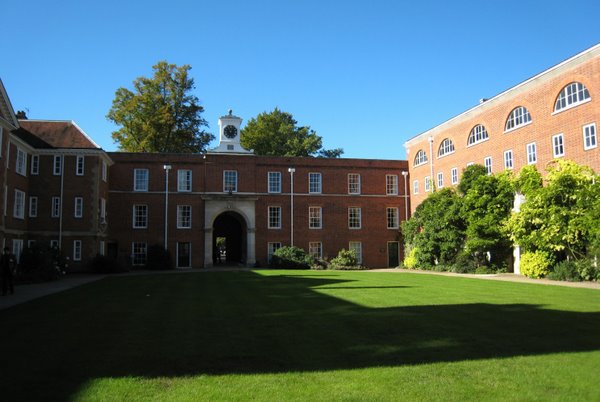 Lady Margaret Hall
©Iolanthe
Part 1:
Friday Night and Saturday morning – or Speckled Hens and Fairies.
I love Oxonmoot! This was my fourth one and I was thrilled to be back for another weekend of Hobbiting about, along with Marbretherese and Jonick. It was also nice to be back at Lady Margaret Hall which is one of the more homely colleges – grand but not TOO grand. More of a Rivendell than a Minas Tirith.
Marbretherese and I arrived quite in the early afternoon with a car load of stuff for the Art Exhibition, which we headed straight for with no mucking about. Marbretherese, carrying all her stuff and half of mine without any trouble, headed smartly off through the grounds at a cracking pace while I lumbered along behind, fending off attacks from my own bags and a very cantankerous wooden browser. We were late last year and nearly gave Becky the vapours, so this year we decided to be Good and arrived so early that the exhibition panels were still being set up. Becky had given us a whole corner and a table to play with, and Marbretherese unpacked her simply humungously sized ‘He cast him a lappett…’ and swiftly had it up on the panel, with the minimum of fuss, while I tied endless reams of hanging wire in knots and harrumphed about. I think my problem with hanging wire is that I just don’t trust it unless I use enough to suspend an elephant and tie more knots in it than you’d see in a macramé competion. Whenever I tried to hang anything, the wire was either too long or too short. If it was too long and I shortened it, it was then too short. If it was too short and I lengthened it, it was then too long. I spent ages unpicking wire knots or doubling wire up until eventually everything was just a hopeless mess. Following my crisis two years ago with the Velcro, Becky is now used to me wailing in the art room while I make a pigs-ear from assorted hanging materials. Marbretherese, who had very annoyingly finished in a quarter of the time, was standing eyeing my efforts with a faintly saintly air. Eventually I had everything up and all my cards and prints out, and could admire all the other lovely things in the room, of which more later as we revisited it on Saturday for a
proper look i.e. one where I didn’t have knots before my eyes and beads of panic induced perspiration.
 Our stuff finally up in the corner of the Art Room.
©Iolanthe
We then headed over to get our room keys and discovered that we were in the new hall of residence, which was being built rather noisily while we were at Lady Margaret’s last year. Pipe-Partridge Hall – which sounds like a good name for an up-market Hobbit Hole – was luxury. The rooms are very nice. Imagine my delight to discover that there was still a bonsai bathroom! Slightly better arranged than the old ones, but still teeny-weeny and impossible to rinse your face without getting into an argy-bargy with the taps. According to a plaque over the door I was in ‘Valerie Flint’s Room’. Good old Valerie!
After a cup of tea and some unpacking we went over to register, and it was lovely to meet up with old friends in the Hospitality Room (a grand name for do-it-yourself tea bags and biscuits). In fact we lurked there for ages and caught up with ‘Geordie’ from MeJ and his wife Louise (who we know well) and, to our delight, Beren, who were afraid of missing because we hadn’t a clue what he looked like. It’s wonderful to put a name to a face. In fact he has such fame in the online Tolkien community that he found (to his amazement) that everyone knew him. Beren – it was a huge pleasure to finally get to meet you! He had travelled with Yohan Vanhecke, who was going to give a talk on Tolkien and Belgium. He gave us the gist of it and it really sounded very interesting but, alas, he was up against Charles Bressler in the Programme and I had to admit that we just weren’t going to make it. Sorry Yohan! In fact we were worried whether anyone would make it because in the Programme, in the bit that gives some information about the speaker, it said:
[no confirmation or information recd. I EMAILED HIM]. Poor Yohan. In the end he had a small, but interested group who had faith that he was actually there. In the midst of all this, Jonick turned up and we retreated back to our rooms to get ready for the Banquet.
 Eating by candlelight in the Hall
©Iolanthe
I really enjoy the Banquet. I like the candle light in the big, wood panelled hall, and all those rather stern looking academic ladies staring down at us we pass around the vegetables. I can hear them thinking ‘Dauphinoise potatoes! Plain boiled was good enough in my day’. Lady Margaret Hall does rather good food so we (by which I mean ‘I’) overdid it a bit. Teeny weeny chocolate dainties were served with the teeny weeny coffee and we could hardly cram them in.
After the meal we headed to the bar and caught up with Ruth and Alex (last seen at the Festival), and Anke - it was lovely to talk about the up-and-coming
lHeren Istarion calendar put together by our own Parmastahir and his daughter. We both agree it looks lovely! I ordered some rather strong Old Speckled Hen (a Hobbit brew if there ever was one) and we spent the rest of the evening with Beren and Yohan, and (from what I remember) we spent most of the time laughing but I can’t remember for the life of me about what. It may have been the Old Speckled Hen.
I would like to say that I was up bright and early the next morning because I couldn’t wait to try out the new bonsai bathroom, but I awoke late and shambled in there with a bad case of the Orcs. It may have been the Old Speckled Hen. Within two minutes I had knocked my chin on the mixer tap and wiped my face in the white towelling floor mat, which was nonchalantly masquerading as a face towel. For the sake of people with soap in their eyes they should have ‘MAT’ written on them in Very Large Letters. The shower cubicle was round and very tight, rather like being doused in an up-market pipe, and after knocking my elbow several times on the shower equipment (it may have been the Old Speckled Hen) it occurred to me that anyone on the chubby side would probably have been completely stuck, unless they could soap their way out. Not that I am complaining as not everyone had the luxury of their own en-suite shower pipe. I was still blundering about when Marbretherese and Jonick knocked on my door to go over for breakfast. By the time I got over to the Dining Hall there was an enormous queue and they had run out of trays, cereal bowls and butter. This was, apparently, because Everybody Had Arrived Together. I swear I didn’t arrive together with anyone. In fact I’ve never been less together. When I finally got my sausage, egg, tomato and nice crispy bacon and had progressed past the coffee dispenser, it was all cold. I could just see Marbretherese and Jonick calmly finishing the last of theirs at a distant table. By the time I had caught up it was time to go over to the brand spanking new Simpkins Lee Lecture Theatre for the first talk of the day, which was being given by Dimitra Fimi. Dinitra is lecturer in English at the University of Wales Institute and her book
Tolkien, Race and Cultural History: From Fairies to Hobbits has just won the Mythopoeic Scholarship award in Inklings Studies. I was thrilled that she was speaking at Oxonmoot as I missed her paper at the Festival in the Shire because of a scheduling clash.
 Dimitra getting ready to talk fairies in the Simpkins Lee Lecture Theatre
©Iolanthe
Dimitra’s talk was about ‘Tolkien and the Fairies: Faith and Folklore’. I have to admit I was really looking forward to this as a bit of a fairy lover myself. I mean, they are real, right? Dimitra had had the luxury of reading Tolkien’s original manuscripts for ‘On Fairy Stories’ and his rather wayward handwriting had proved a real challenge, although we now have the wonderful, fully edited version by Verlyn Flieger and Douglas Anderson. Dimitra wanted to look at Tokien’s belief in real elves and fairies as elemental spirits of nature, not in Middle-earth, but right here. She examined old folklore beliefs that fairies were spirits of the dead – especially of un-baptised babies – or were a ‘pigmy’ race that modern humans displaced and who had then faded away into folkloric memory. She then looked at Tolkien’s statements that he kept an open mind about fairies and his thoughts that they were minor spirits, involved in creation and living in another mode from us, although appearing sometimes in human form. A spiritual agent in the forming of – say – a tree from the ‘divine Tree-idea’. In the Lost Tales, Tolkien makes it clear that these natural beings are NOT elves, who are part of creation, but lesser Vali. In his earliest writings, Tolkien was still very influenced by inherited Victorian ideas of fairies and the lesser Vali include most of the Victorian pantheon of fairy beings. After The Lost Tales they had evolved into the Maiar. Tolkien’s developed view of elementals is that ‘the normal world, tangible, visible, audible, is only an appearance. Behind it is a reservoir of power which is manifested in these forms’ (On Fairy Stories). Dimitra then talked about his Catholicism and pointed out that Newman’s understanding of angels is very close to Tolkien’s view of fairies, i.e. nature is inhabited and moved by unseen spiritual powers, whatever name you give to them. Tolkien’s friend Wiseman saw Tolkien’s enchantment with fairies as something from the past. His view of nature was of a process, not something of mystery and wonder. But Tolkien’s Catholicism allowed for more mystical beliefs, embracing the idea of minor spiritual powers where Protestantism saw elves and fairies as a case for iconoclasm.
I really enjoyed Dinitra’s talk (though I think my summary is pretty mangled really as I was listening more than writing…) and there was a very lively Q&A afterwards. Dimitra pointed out that Smith of Wootton Major is Tolkien looking back at his first ideas of fairies (the Fairy Queen on the Great Cake) from his later, mature position (the meeting with the real Fairy Queen). She also pointed out that popular belief and interest in fairies died with the horrible reality of the Great War, where they disappeared almost entirely from art and literature. It was also mentioned that elves and fairies were the same thing in Victorian times, but, after Tolkien, they are now different as he has re-defined them. The Q&A was a real pleasure with some quite awesome knowledge floating around the room.
After Dimitra’s talk we stayed put for Charles Bressler’s – or rather I tried to, but more of that in
Part 2! . I haven't actually seen anyone 'do' Aragorn yet. I think they are all intimidated by his great and glorious Viggoness
  .
. .
.
 ).
).


 . I've been focussing too much on painting and other much less interesting stuff. I do indeed have a tale to tell about where I got too, and luckly I have extensive notes to make up for my diminishing memory!

