Page 1 of 15
The Silmarillion - General Discussion
Posted: Tue Aug 16, 2005 12:06 am
by Riv Res
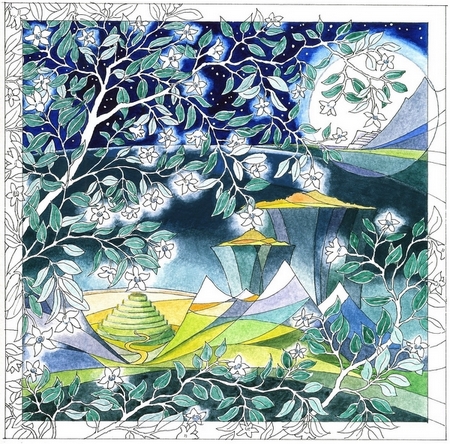
Telperion's Children
© Iolanthe
The Silmarillion
In the year of 1916, J.R.R.Tolkien’s life was all but calm. Besides marrying the love of his life Edith, he fought in World War I. While at home the same year on medical leave he is notified two of his closest friends have been killed in the war. All this and he decides to start writing what becomes a most monumental task which he would continue to work on for 57 years till his death 1973.
What started as scribbles in a notebook labeled “
The Book of Lost Tales” became the mythological seeds from which grew the
Lord of the Rings elm, oak and ash.
It was Tolkien's son Christopher who took on the monumental task of collecting, deciphering and recording the tales in fragments or as whole stories into one collective volume called
The Silmarillion. The tales start from the beginning of time when Eru first played with music to the end of the third age. It was published in 1977 four years after it’s authors death.
This thread is for all discussions related to
The Silmarillion. As always please be mindful of the
House Rules.
Posted: Mon Sep 19, 2005 4:18 am
by Varda
Right now I am listening to
The Silmarillion on CD as I go back and forth to work. Though I read it many years ago, this time around I feel as though I am discovering it for the first time!! ( Perhaps in part due to the wonderful narration of Martin Shaw). So many heartrendering stories, that when I finish, I plan on starting all over again!

Posted: Mon Sep 19, 2005 4:28 am
by Merry
How appropriate to have our first post about The Silmarillion from Varda's namesake!
I must admit to having read the book only a couple of times. I find it hard slogging. I think one of the reasons is because JRRT never really prepared it for publication. I think, too, that hobbits are the lens through which we see M-e in LOTR, and I miss that lens.
Undoubtedly, though, this reveals my severe limitations for reading great literature. I would be glad to be taught better by those who know more.
Posted: Mon Sep 19, 2005 4:54 am
by Varda
I have to admit it is a much harder read than LoTR or many of Tolkien's other works. SO many things to keep track of...

BUT it is much clearer to me after listening to the book, and that's coming from someone who
swore she would never listen to any audio book!

It has much more impact on me now...and raises so many questions/thoughts on the complete story.
How could such evil as Melkor come from one so great as Ilúvatar?
How could Fëanor become so enamored of the jewels he created that he would bring such doom and destruction to his own race? These are just a few that come to mind.
But for those who haven't read
The Silmarillion or have had a hard time following it, try again. The book really give you a true sense of the background/history of all that followed in Middle-earth.

Posted: Mon Sep 19, 2005 5:07 am
by Merry
Varda, your questions are great! They remind me of a curious line from one of Tolkien's letters (and it is too late at night here for me to look up the reference--sorry! Have I broken a house rule already?

) that all real stories are about the Fall. What could that mean? I suppose that, in the most general sense, something has to go wrong for there to be a story. So Melkor is the story of the Fall relative to the Ainur, and Feanor is how the Elves fell.
How an evil choice could come out of a creation made by ultimate goodness is a question theologians have been asking for hundreds upon hundreds of years. Tolkien knew that, but I love his version: Iluvatar weaves Melkor's discordant choices into the grand theme. He doesn't smite Melkor into oblivion. He just weaves a bigger theme.
Posted: Mon Sep 19, 2005 1:27 pm
by Philipa
Interesting thoughts ladies.
something has to go wrong for there to be a story. So Melkor is the story of the Fall relative to the Ainur, and Feanor is how the Elves fell.
We also have to look at the bigger picture and see Tolkien created Iluvatar a loving, forgiving God. There is no perfect being....not even created by Iluvatar himself. A reflection of his own beliefs in the Catholic Church perhaps.
When I first read
The Sil I was really surprised the Elves (those crazy Noldorians especially) were so not perfect. But in the grand scheme of things the Elves learned by there mistakes...eventually....as far was we know.
There is so much to discuss about this book. It is one I loved to read from cover to cover. I found no difficulty reading it myself. I really dig creation myths and legends.
Posted: Mon Sep 19, 2005 3:59 pm
by bruce rerek
Great questions, why indeed? As Merry stated, theologians and philosphers have been debating this question for a few generations. I hold with that free will must include the slippery slope to perdition. Feanor was quite impressed with his craft and this theme will be used again and again as we read through the various texts. Virtue and prudence are the breaks on such a slope. This is not the easy thou shall not variety of prohibition, but the hard questions that an individual must labor over and come to his or her own choice to restrain or to engage. Even the warning of Mandos, that noting shall come of this and all will end in defeat is long remembered in Galadriel.
The Elves in all of thier mighty ability saw virtue in a very narrow sense. To ask what is the virtue in what I shall do isn't a soley ethical question as one of what is the validity of such an action. Does my next action have real soundness in reason and resulting consequence as opposed to I have the will and means to do such an action and I will labor until such an end is achieved.
Oh yes, leave the the ore from fallen stars as curiosties, someone didn't want them and one would be wise to walk past and say, unusual is it not?
Posted: Mon Sep 19, 2005 8:54 pm
by Riv Res
I especially like the chapter that Shippey devotes to
The Silmarillion in his
JRRT: Author of the Century. Even if briefly, he makes a wonderful case that Tolkien's Christian and philological background combined in the creation of the Maia and Elves, to give them angel-like qualities.
Angel means messenger...
Shippey wrote:Gospel means Chrisitan message; means good story; means powerful enchantment. Angel means winged creature of Christian myth; means messenger; means elf.
According to Shippey, Gandalf was the messenger and Eärendil was also. Galadriel is the fallen angel (Philipa's
crazy Noldorians 
), but in this case she did not become a devil. There is redemption in Tolkien's story of the good. And the Silmarils? The
seed of evil?
Posted: Mon Sep 19, 2005 9:30 pm
by Philipa
Riv Res wrote:IAnd the Silmarils? The seed of evil?
That's interesting stuff Riv. The Silmarils always seemed to me to draw out the worst of Feanor and his heirs (or anyone else who desired power) because they grew the seeds of vanity and greed. Two biggies in the book of no-nos.
Posted: Mon Sep 19, 2005 9:42 pm
by bruce rerek
The question I would ask what is the virtue of the silmarillion? What necessitates it and what good would it serve? Evil, in this sense is not found in the object but in the choice that one makes.
IMHO, the Fall is not a sin of disobedience per se, but a sin of omission, that neither man nor woman would own up to their actions. Temptation is always present as is one's intellect, ignorence is hardly a strong case for any deed commited to be pardoned.
Posted: Tue Sep 20, 2005 12:59 am
by Merry
I'm trying to look at this from Feanor's point of view.
The Silmarils were supposed to have contained the last light from the Two Trees, right? The Two Trees which Morgoth caused the nasty Ungoliant to destroy in one of the ugliest acts of wanton destruction I've ever read. So if I'm a true believer in the gifts of the Valar and the chosen status of the Elves, Morgoth's taking of the Silmarils, too, my life's work, would be something quite difficult to forgive.
Except the Valar told Feanor to let it go. That's why Tolkien calls the oath 'blasphemous.'
I think that's the true tragedy of The Sil: Feanor's feelings and actions are kind of understandable. And the Fall of the Elves follows because of him nonetheless.
Posted: Tue Sep 20, 2005 1:34 am
by Varda
I agree w/ Bruce, the evil is not in the object but in the choice over this object. Fëanor was so enamored over the making of the Silmarils that he ..."loved the Silmarils with a greedy love, and grudged the sight of them to all save his father...he seldom remembered now that the light within them was not his own." Add to that the evil workings of Melkor....
But even when Yavanna asked Fëanor for the Silmarils to bring back to life the Light of the Trees after Ungoliant's attack, he refused, stating he rather be slain than give them up, even to the Valar. And then he adds insult to injury and proclaims his oath, thus dooming his children.
Posted: Tue Sep 20, 2005 1:43 am
by Merry
Oh, I had forgotten about Yavanna's request. Good point, Varda. Okay, Feanor is unforgiveable!
Posted: Tue Sep 20, 2005 2:30 am
by Varda
Perhaps it would be better to say elves were not so perfect as we would like to believe!!

Posted: Tue Sep 20, 2005 2:40 am
by Merry
Yes. They're pretty perfect in LOTR. Whenever there's an elf around, you get the feeling that everything is in good hands. (I was all for Elrond sending Glorfindel on the Fellowship and leaving behind the useless hobbits!) But perhaps if I had read The Sil before LOTR, I would have thought differently and been a little more suspicious of the elves, particularly Galadriel.