Page 1 of 4
The Line of Elros
Posted: Mon Jun 29, 2009 4:53 am
by Merry
The Line of Elros:
Kings of Numenor
from the founding of the city of Armenelos to the Downfall
A short chapter of Unfinished Tales, these seven pages or so, plus editorial notes, outline the dynasty of twenty-five kings and queens who ruled Numenor for its 3000 year history in the Second Age. (There is a terrific graphic family tree at another site that helps to make things clearer:
http://www.tuckborough.net/numenoreans.html)
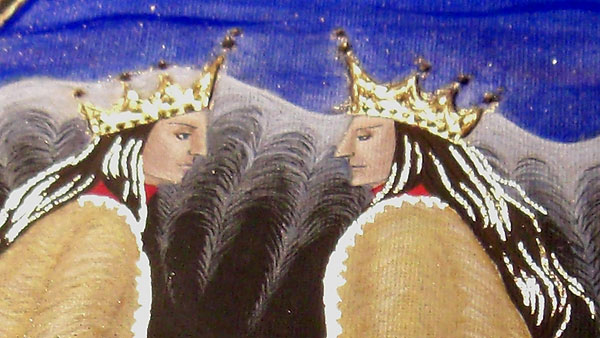 Elrond and Elros
(artist unknown)
A prime purpose of this chapter seems to have been linguistic: the Quenyan and Adunaic titles for the rulers show Our Author's signature inventiveness. Whether intended for publication or not, these pages also show the subcreative work that made Tolkien’s world seem to be real history. And just as is the case with real history, this family tree has a few twists and turns! Fortunately so, since the main line is destroyed in the Downfall. Fortunately for Middle-earth, there is another line--one that ends in Rangers!
Posted: Tue Jun 30, 2009 5:27 am
by Merry
So here's something I never realized before:
The fourth king of Numenor was Tar-Elendil. His oldest child was a daughter, Silmarien, but only males could take the throne at the time, so her younger brother, Tar-Meneldur, was the fifth ruler. Tar-Meneldur's son was Aldarion, and he changed the laws so that his only child, a daughter, Ancalime, could be queen. Her descendents ruled, with a couple of twists and turns, until the Downfall.
If Silmarien could have become queen, then her line would have been the ruling line. Her son was Valandil, and the line eventually produced Elendil, Isildur, and Aragorn! So it's sort of like if the laws were as they should have been, allowing women to rule, Aragorn would have been the true king anyway. And Silmarien's line produced the Lords of Andunie, who were the Faithful, and maybe if they had ruled, Numenor would not have been destroyed.
So is this a bit of a feminist lesson from Tolkien?

By the way, Tar-Elendil gave a couple of important heirlooms of his house to Silmarien: the ring of Barahir and the Elendilmir.
Posted: Tue Jun 30, 2009 10:35 pm
by Chrissiejane
It's the level of detail and the historical accuracy that the Professor has woven into these brief biographies that makes this short chapter so impressive. I can appreciate that it was not intended for publication, but it does so much to bring colour and life to the Númenórian lineage.
Posted: Wed Jul 01, 2009 11:09 am
by Iolanthe
I'm going to try and read this this afternoon to catch up - what you've spotted is amazing, Merry

. I hadn't realised that either. So the 'eldest child to eldest child' line is the direct line to Aragorn.
It interesting to ponder how things would have been different if Silmarien's line had ruled and Numenor had stayed faithful. There would never have been any ruling Numenoreans in Middle-earth. There would have been no great kingdoms apart from Gil-galad's, who would have been without allies (unless the Numenoreans still sailed over as Aldarion had done. But that's isn't the same as a ruling power base there). The Rohirrim would never have found allies in Gondor (the Steward, Cirion, and Eorl is a later chapter which we'll come to). The whole balance of power in Middle-earth would have been different and Sauron would have overrun it very early on. There would have been no safe Shire with homely hobbits....
Maybe it's just as well the Faithful had to leave for Middle-earth!
Posted: Wed Jul 01, 2009 2:17 pm
by Lindariel
I don't know about that, Iolanthe. You're assuming that Silmarien's descendants would have remained Faithful, but insular -- content with their beautiful island and having no interest or dealings with the Elves of Middle-earth or their distant kin through the line of Elrond. I can't imagine that. In fact, I think they would have been even MORE likely to develop close relationships with the Elves of Middle-earth.
Nonetheless, where there is power, there often is also jealousy and strife, and you know that Sauron would have made the most of any such situation. I suspect that Numenor, in one way or another, would have been targeted for destruction by Sauron, and that the Akallabeth was inevitable. This is Arda Marred, after all, and Morgoth's influence in the Song of the Ainur was pervasive, if ultimately overcome at the End of All Things.
Posted: Thu Jul 02, 2009 11:30 am
by Iolanthe
Lindariel wrote:I think they would have been even MORE likely to develop close relationships with the Elves of Middle-earth.
That's why I added the comment that sending support from overseas or establishing harbours isn't the same as actually having your powerbase actually located in Middle-earth. I'm sure they would have maintained connections and support but I don't think it could ever have been at the level that the exiled Numenoreans built there and maintained. I think it must, inevitably, been significantly weaker.
Reading the histories of the line of Elros it's amazing Tolkien created all these individual rulers and the main events of their reigns just to give background and focus to his timelines. What an incredible imagination he had.
Posted: Thu Jul 02, 2009 4:01 pm
by Merry
So if Elros' line hadn't had crazy, adolescent Aldarion playing sailor and avoiding his wife, Sauron would have won? O happy fault!

I guess, to agree with this, I'd have to know more about Silmarien's line down through Elendil. I'm going to do some studying.
Posted: Thu Jul 02, 2009 4:58 pm
by Chrissiejane
Happy fault indeed, but after Aldarion it was still "touch-and-go" because his daughter Ancalimë, when she succeeded him, totally cold-shouldered Gil-Galad - perhaps to spite her father, either consciously or subconsciously??
Then there are several generations of equally proud and wilful women whose behaviours really affect the direction taken by the lineage: not least of whom is the second Númenórian queen, Telperien. She remains unwed ( they were real man-haters, it seems, these female descendants of Aldarion!!) so the next king is her nephew, Minastir.....and it is he that exhibits the will to assist the Eldar and so sends the fleet to support Gil-Galad against Sauron.
So in the end, by some kind of skin-of-his-teeth device, Aldarion's many faults and failings eventually result in a satisfactory outcome, via the twists and turns of the succession to the Númenórian throne.

Posted: Thu Jul 02, 2009 6:08 pm
by Merry
Right! This is a real soap opera, isn't it? I'm wondering if anyone who knows European history better than I do recognizes any of these lineage twists in real history?
Posted: Thu Jul 02, 2009 7:05 pm
by Chrissiejane
England in the 8th, 9th, 10th century perhaps? Three families were all vying for the English throne. They shared some relatives in common, due to "political" laisions and intermarriages. The throne(s) of England changed hands several times between the Danes, the Normans and the Anglo-Saxons, amidst much intrigue and political wheeler-dealing, with ambitious family members, related to each other across the three families, all making their claims - or finding themselves elevated almost by accident. It does in many ways remind me of the convoluted lineage of Númenor.
Posted: Fri Jul 03, 2009 3:40 pm
by Merry
Thanks, Chrissiejane! As an American, not knowing this history very well, I look at the family tree in the line of Elros and it looks like a soap opera, i.e., fiction, like all the husbands of Erica Kane or something. But do you think a person from the UK would look at the tree and say, yes, that's the way real life is?
Posted: Fri Jul 03, 2009 4:58 pm
by Chrissiejane
That's a good question Merry.

I think the period I've chosen is perhaps less interesting and less well-known to the average Brit than later history, for example about the Tudors and the Stewarts, because in the earlier centuries the country of England was far less settled as an entity - the borders weren't fixed yet, bits of the country could change hands quite readily as the Normans and the Danes slugged it out, there were numerous claimants to the throne based on the power of the region they came from....but in many ways, for me at least, that serves to increase the parallels with Middle Earth. So too do the names of the main movers and shakers at that time, particularly the Danish and the Anglo contingents.
I do think, however, that even in later and better-known periods of UK history it's possible to see that the anxieties and machinations of assuring the "right" succession are reflected in the Professor's history of the Númenórian Kings and Queens.
What a treat it would be to find that there are even more tales stashed away somewhere relating the adventures and lives of these characters!
Posted: Fri Jul 03, 2009 7:34 pm
by Iolanthe
Reading the machinations in the Line of Elros seemed quite normal to me, i.e. not exaggerated 'fiction' so - yes - the throne of England wasn't that much different through a large part of it's history, as Chrissiejane has said. In fact the Numenorean line is much more stable

.
I see Queen Elizabeth the First in all those Queens (especially Tar- Telperien) that either refused to wed or, if they did, did it reluctantly. But the motives are all different of course. QE1 didn't hate men, far from it, but saw reigning alone as the only way to keep England stable and independent of other powers.
It's interesting that the Numenorean women were even longer lived than the men - though I know women are generally slightly longer lived than men. In the long line of English, and then British Kings and Queens the longest reigning have been Queen Elizabeth 1, Queen Victoria and Queen Elizabeth 11. They all came to the throne quite young, reigned/reign long and lived/live to a great age. The men are really trailing behind!
Posted: Sat Jul 04, 2009 6:52 pm
by Merry
Coming from a country which has never had a woman president and few other female leaders, this is all kind of interesting to think about. Tolkien had precedent, it seems, to think about women in politics. Some of the women in Elros' line simply refused the throne. One can see why!
Posted: Sun Jul 05, 2009 7:53 pm
by Iolanthe
Looking through the line of Kings you can see the steps that lead to destruction laid out really clearly:
Tar-Minastir (d.1869) loves the Eldar but envy has crept in.
Tar-Ciryatan (d.2035) was 'greedy of wealth' and was the first King to opress the men of Middle-earth instead of aid them. He (possibly) took the sceptre by force.
Tar-Atanamir (d.2221) rules into his dotage because he is unwilling to give up the Sceptre or is life. All that come after him do the same.
Ar-Adunakhor (d.2962) rejects the Quenya tongue and adopts Adunaic. He also takes a title that means 'Lord of the West' which is blasphemous.
Ar-Gimilzor (d.3177) persucutes the faithful and 'revered nothing, and never went to the Hallow of Eru.
Ar-Pharazon (d.3319) the last King of Numenor usurps the Sceptre and worships the false god, Morgoth and makes war on the West.
There are good kings and queens inbetween, but it's a progression from envy, to greed and opression, to the clinging to power of the despot, then insularity and the seeds of fascism, blasphemy, persecution and arrogance and finally the worship of evil for self-gain.
When you strip it down it's a sorry tale of decline from the noble men who aided the Eldar and won the gift of Numenor from the Valar. All the evil which the Valar thought they were removing them from has come home to roost and then some!